What is Bates numbering?
Bates numbering is a fixed identifier stamped on every page of a document set, such as SMITH-000123, so any page can be referenced exactly. Here is how it works.
Written by the ThreadProof team · Last updated · About the team
Changelog: Added prefix conventions and the counter-continuity section.
Quick answer
Bates numbering stamps a unique, sequential identifier on every page of a document set, usually a prefix, a separator, and a zero-padded number such as SMITH-000123. It lets anyone refer to one exact page across an entire production, no matter how many documents it contains.
Bates numbering comes from a mechanical stamping machine and survives because it solves one problem perfectly: naming a single page out of thousands so two people can be certain they are looking at the same thing.
A Bates number is not a page number inside one file. It is a counter that runs across every page of every document in a production, so it never restarts.
Steps
- Choose a prefix. Pick a short prefix that identifies the producing party or the matter, such as SMITH or ACME. Use the same prefix for the whole production.
- Choose the padding. Zero-pad to a fixed width, commonly six digits, so the numbers sort correctly in any list: SMITH-000001 through SMITH-001204.
- Set the starting number. Start at 1 for a first production, or continue from the last number used if you are producing a further set for the same matter.
- Stamp every page. Every page gets a number, including cover pages, blank separators, and appendices. Skipping pages defeats the purpose.
- Keep the counter. Record the last number used. The next production continues from there so no number is ever reused.
Bates numbers versus page numbers
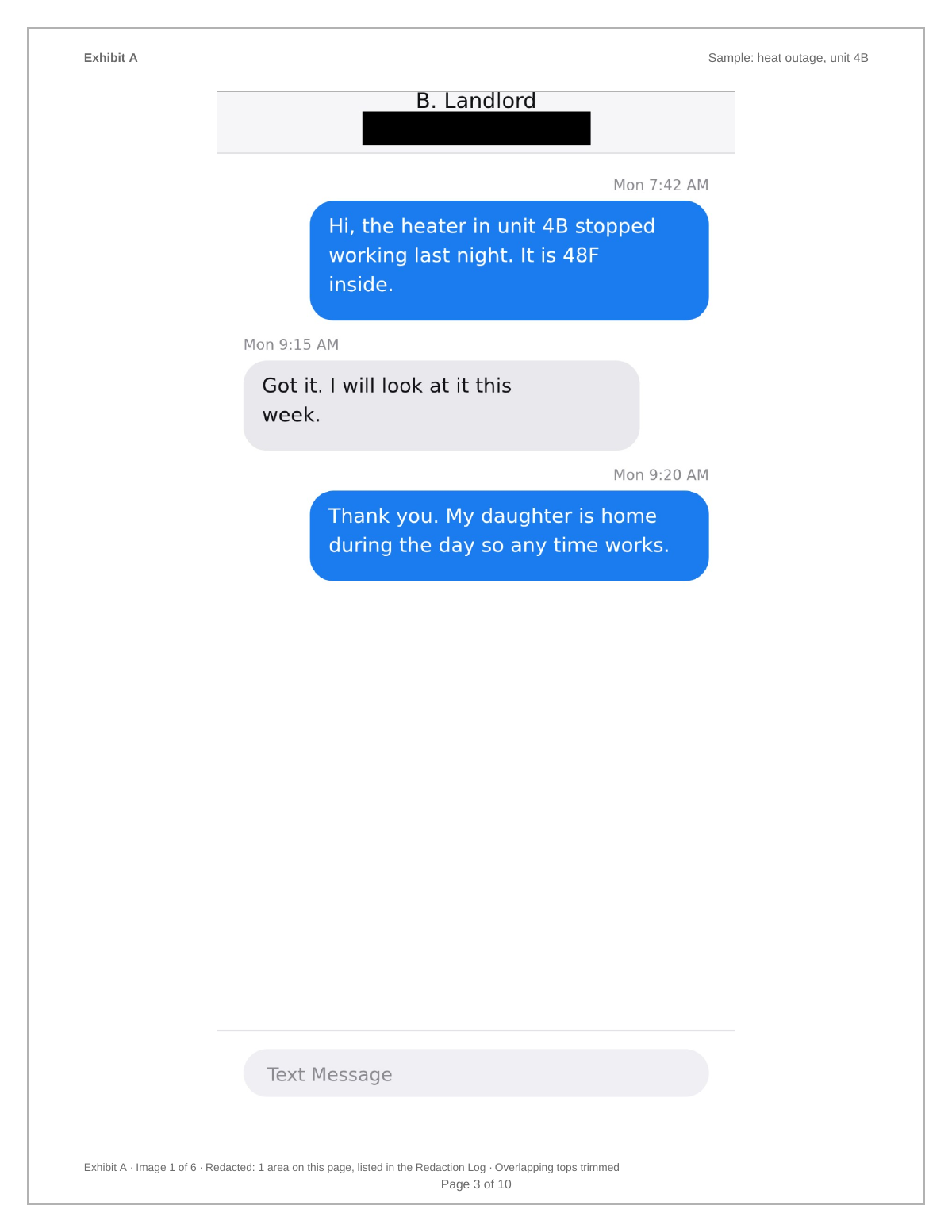
A page number tells you where you are inside one document. A Bates number tells you which page of the whole production you are holding. Both can appear on the same page, usually the page number in the centre of the footer and the Bates number in the bottom right corner.
When you need it and when you do not
A single twenty-page exhibit for a small claim does not need Bates numbering; page numbers with a total are enough. Bates numbering becomes worth the setup once you are producing multiple documents, exchanging them with another party, or expect anyone to cite pages in writing.
- One short exhibit: page numbers with a total.
- Multiple exhibits exchanged with another party: Bates numbering.
- Ongoing productions in the same matter: a continuing counter.
What to include
- A consistent prefix for the matter or party.
- Zero-padded sequential numbers with a fixed width.
- A number on every page including covers and appendices.
- A record of the last number used.
- Placement that does not cover content.
Common mistakes
- Restarting the counter for each document in a production.
- Changing the prefix partway through.
- Reusing numbers after re-exporting a corrected document.
- Stamping over the content of the page.
- Using unpadded numbers, which sort incorrectly in file lists.
What the PDF should contain
- Bates number in the bottom right of every page.
- Page number and total in the footer centre.
- A cover page naming the production and prefix.
- A log of the number range used.
- A hash appendix for the source images.
Build this exhibit on your phone
Add your screenshots, redact what should not be in the record, and export a numbered PDF. Nothing is uploaded.
Frequently asked questions
- What does a Bates number look like?
- Typically a prefix, a separator, and a zero-padded sequence, such as SMITH-000123. The prefix identifies the party or matter and the number identifies the exact page.
- Is Bates numbering the same as page numbering?
- No. Page numbers restart in every document; a Bates number is unique across the whole production and never restarts or repeats.
- Do I need Bates numbering for a small claim?
- Usually not. Continuous page numbers with a total are enough for a single exhibit. Bates numbering pays off when several documents are exchanged.
- Where should the number sit on the page?
- Conventionally the bottom right corner, clear of the content. Consistency of placement matters more than the exact position.
- What if I have to re-export a document?
- Keep the original numbers if the pages are unchanged. If pages were added, continue the counter rather than renumbering the existing pages.
Summary
- A Bates number uniquely identifies one page across an entire production.
- Use a fixed prefix, zero padding, and a counter that never restarts.
- Small single exhibits usually need page numbers with a total, not Bates numbering.
Related guides
Cite this guide
ThreadProof team. “What is Bates numbering?.” ThreadProof, updated 2026-09-01. /guides/what-is-bates-numbering
ThreadProof helps you format and organise documents. Nothing here is legal advice, and ThreadProof makes no representation about how any document will be treated by any court, agency, or other body. Rules differ by place and by matter. Questions: abe.mainlinesites@gmail.com.