How to present text messages in court
How to present text messages in court: bring one numbered PDF exhibit per conversation, copies for everyone, and a short index so any message can be found by page number.
Written by the ThreadProof team · Last updated · About the team
Changelog: Added the hearing-day checklist and the index page guidance.
Quick answer
Present text messages as one printed, numbered PDF per conversation, with a cover page and a short index, and bring enough copies for the judge, the other side, and yourself. Refer to messages by page number rather than scrolling a phone, and keep the original screenshots available.
Presenting text messages in court is mostly a logistics problem. The content is already fixed; what decides whether it lands is whether anyone can follow it. A stack of prints with no order, or a phone passed across a table, wastes the short time you get. One numbered document per conversation, with copies for everyone in the room, solves it.
Formatting is not legal advice, and rules differ by court and by matter. Check the filing rules for your court, or ask your lawyer, before you decide how many copies to bring and in what form.
Steps
- Build one exhibit per conversation. Give each thread its own PDF with its own cover page and page numbering. Mixing conversations forces the reader to work out where one ends and another starts.
- Add a one-page index. List the key messages with their date and page number: for example, 14 March, promise to repay, page 9. An index turns a long exhibit into something a reader can navigate in seconds.
- Print enough copies. Bring at least three: one for the judge, one for the other side, and one for yourself. Check your court's rules, since some require more, and bring the digital file on a drive as well.
- Refer to page numbers out loud. Say the page number before you read anything. It keeps everyone on the same page literally and avoids the pause while people search.
- Bring the source device. Have the phone with you, charged, with the conversation still on it. If anyone wants to compare the printout with the screen, that comparison takes seconds.
- Keep a clean copy. Do not write on the exhibit copies you hand over. Keep your notes on a separate sheet so the exhibit stays as exported.
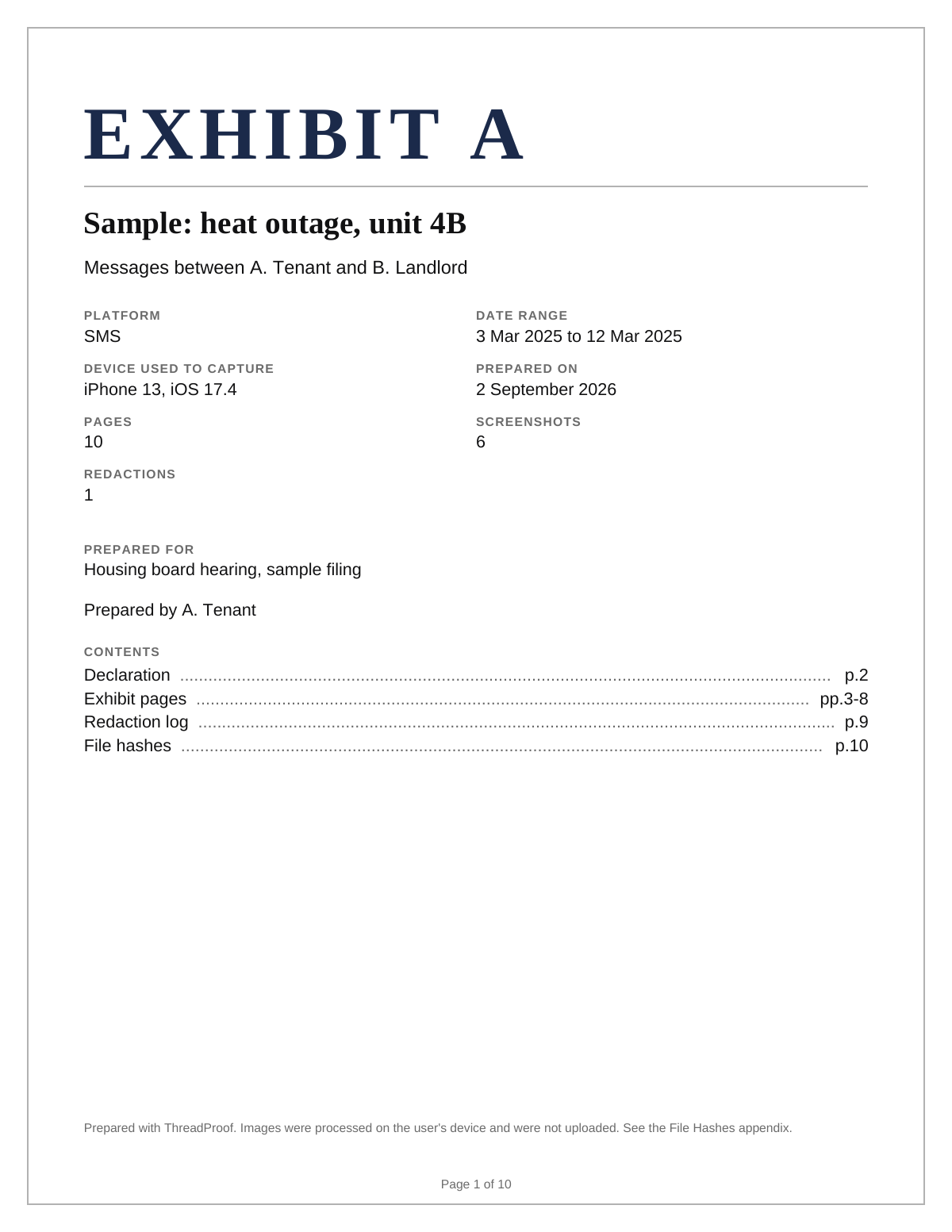
What a judge or clerk sees first
The first page decides how the rest is received. A cover page with the matter name, the parties, the platform, the date range, and a page total reads as organised. A first page that is a cropped screenshot with no context reads as a pile. That difference costs nothing to fix.
Answering the two obvious questions
Expect to be asked whether that is the whole conversation and whether anything has been changed. Continuous numbering with a total answers the first. Keeping the original screenshots and a hash appendix gives you a concrete answer to the second: the fingerprints in the exhibit can be recomputed from the originals.
- Whole conversation: continuous numbering plus a stated date range.
- Unchanged: original screenshots plus a hash appendix.
- Who it is with: contact header captured at the top of the thread.
Redactions in the room
If you covered anything, be ready to say what and why in one sentence. The redaction log gives you the page numbers, so the answer is short and specific rather than vague. Never redact something that changes the meaning of the surrounding messages.
What to include
- One exhibit per conversation, labelled sequentially.
- A cover page and a one-page index.
- Continuous page numbers with a total.
- The redaction log, if you redacted anything.
- Copies for the judge, the other side, and yourself.
Common mistakes
- Passing a phone around instead of handing over paper.
- Bringing one copy and expecting the court to make more.
- Highlighting or annotating the exhibit copies you hand over.
- Presenting isolated messages with no surrounding days.
- Leaving the phone at home or arriving with it uncharged.
What the PDF should contain
- Cover page with matter, parties, platform, and date range.
- Index page pointing to key messages by page number.
- Chronological screenshots on numbered pages.
- Redaction log.
- Hash appendix.
Build this exhibit on your phone
Add your screenshots, redact what should not be in the record, and export a numbered PDF. Nothing is uploaded.
Frequently asked questions
- How do I show text messages to a judge?
- Hand over a printed, numbered exhibit rather than a phone. Refer to page numbers when you speak, and keep the phone available in case anyone wants to compare a page with the screen.
- How many copies should I bring?
- Bring at least three, and check your court's rules because some require more. Bring the PDF on a drive too, in case a digital copy is easier to accept.
- Can I highlight the important messages?
- Keep the exhibit copies clean. Use an index page that points to the key messages by date and page number, and keep any highlighting on your own working copy.
- What if the other side says the messages are fake?
- Have the original screenshots and the device with you, and point to the hash appendix, which lets anyone recompute a fingerprint from the source file and compare it with the exhibit.
- Should I include messages that hurt my case?
- Cutting a conversation to remove what is inconvenient is the fastest way to lose credibility, and the other side usually has the same thread. Present continuous date ranges.
- Do I need a lawyer to do this?
- Organising a document is not legal work. Whether you need a lawyer for the matter itself is a separate question, and ThreadProof does not give legal advice.
Summary
- One numbered exhibit per conversation, with a cover page and an index.
- Bring copies for everyone and refer to messages by page number.
- Keep the phone and the original screenshots available for comparison.
Sources and further reading
Related guides
Cite this guide
ThreadProof team. “How to present text messages in court.” ThreadProof, updated 2026-09-01. /guides/how-to-present-text-messages-in-court
ThreadProof helps you format and organise documents. Nothing here is legal advice, and ThreadProof makes no representation about how any document will be treated by any court, agency, or other body. Rules differ by place and by matter. Questions: abe.mainlinesites@gmail.com.