How to write a declaration describing text message evidence
A declaration describing text message screenshots covers who you are, whose phone it is, how and when you captured it, and what you redacted. Template language included.
Written by the ThreadProof team · Last updated · About the team
Changelog: Added the numbered template paragraphs and the redaction paragraph.
Quick answer
A declaration about text message screenshots states who you are, which device the messages are on, who the conversation is with, when and how you captured the screenshots, that they show the conversation as it appeared, what you redacted and why, and that the exhibit is complete for the stated date range.
A declaration is a short written statement of facts you know first hand. When it accompanies screenshots, it explains where the images came from, because the images cannot explain themselves.
This page shows the structure and neutral template language. It is formatting guidance only. Requirements differ by forum and by matter, so check the rules that apply to you or ask a lawyer.
Steps
- Identify yourself and the device. State your name, your role in the matter, and that the messages are on a device you own and control, naming the make and model.
- Identify the conversation. State who the conversation is with, how that person appears in your contacts, and the platform used.
- Describe the capture. State when you took the screenshots, on what device, and that you captured the conversation continuously across the stated date range.
- Describe the exhibit. State that the exhibit contains the screenshots in chronological order, with page numbers, and give the total page count.
- Describe the redactions. State what categories you covered, that solid boxes were used, and that each is listed in the redaction log page of the exhibit.
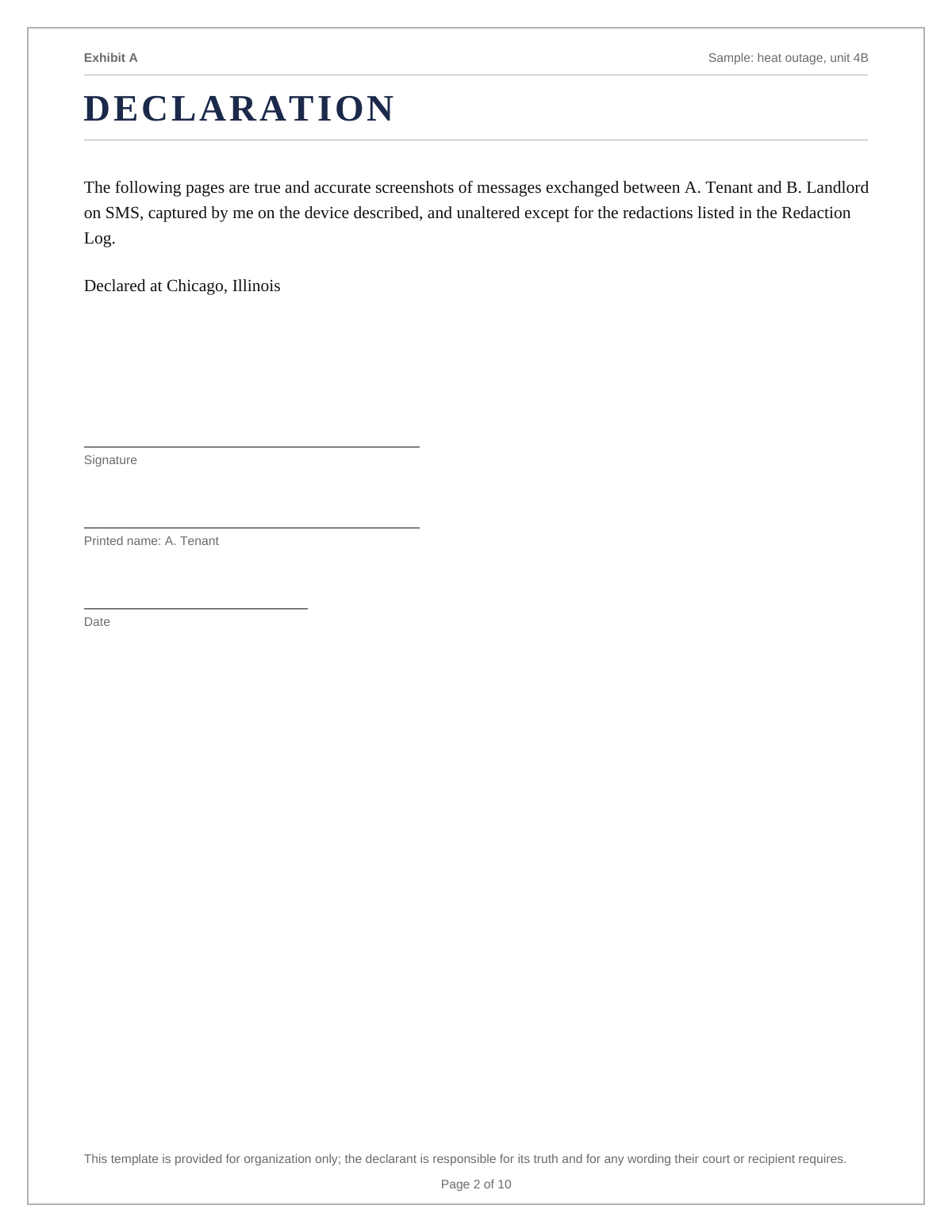
Template paragraphs
Adapt this neutral language to your own facts. Do not state anything you do not know first hand, and do not describe the messages themselves as proving anything.
- 1. I am [name]. I make this declaration from my own knowledge.
- 2. The messages in Exhibit A are on my [make and model], which I own and use.
- 3. The conversation is with [name], saved in my contacts as [contact name], on [platform].
- 4. On [date] I took screenshots of the conversation from [start date] to [end date], in order.
- 5. The screenshots in Exhibit A show the conversation as it appeared on my device on that date.
- 6. I have covered [categories] with solid boxes. Each is listed on the redaction log page.
- 7. Exhibit A contains [N] pages, numbered consecutively.
What to leave out
Leave out argument, interpretation, and anything you were told rather than saw. A declaration describing an exhibit should be short, factual, and boring, which is exactly what makes it useful.
What to include
- Your name and relationship to the device.
- The other party and the platform.
- The capture date and the range captured.
- The exhibit label and total page count.
- The redaction categories and where they are logged.
Common mistakes
- Arguing the meaning of the messages inside the declaration.
- Stating facts you learned second hand as if you saw them.
- Saying the exhibit is complete when you selected individual messages.
- Omitting the redaction paragraph when the exhibit is redacted.
- Giving a page count that does not match the exhibit.
What the PDF should contain
- The declaration as its own document, not inside the exhibit.
- Exhibit with cover page and page total matching the declaration.
- Chronological message pages.
- Redaction log referenced in the declaration.
- Hash appendix.
Build this exhibit on your phone
Add your screenshots, redact what should not be in the record, and export a numbered PDF. Nothing is uploaded.
Frequently asked questions
- What is a declaration for screenshots?
- A short written statement of first-hand facts describing where the screenshots came from, when they were captured, what device holds them, and what was redacted.
- Does the declaration go inside the exhibit?
- Usually it is a separate document that refers to the exhibit by its label and page count. Keep the exhibit itself free of commentary.
- Do I need a notary?
- That depends entirely on the forum and the type of statement. Check the rules that apply to your matter or ask a lawyer; ThreadProof does not give legal advice.
- Should I describe what the messages mean?
- No. Describe how the exhibit was made. Interpretation belongs in argument, not in a declaration about capture.
- What if I only captured part of the conversation?
- Say so precisely: state the range you captured and that you did not capture outside it. Never describe a partial capture as the complete thread.
Summary
- Describe the device, the parties, the capture date, the range, and the redactions.
- Keep interpretation and argument out of the declaration.
- Make the page count in the declaration match the exhibit exactly.
Related guides
Cite this guide
ThreadProof team. “How to write a declaration describing text message evidence.” ThreadProof, updated 2026-09-01. /guides/how-to-write-a-declaration-for-text-message-evidence
ThreadProof helps you format and organise documents. Nothing here is legal advice, and ThreadProof makes no representation about how any document will be treated by any court, agency, or other body. Rules differ by place and by matter. Questions: abe.mainlinesites@gmail.com.